
Substack Recommends Nazis
A brief history of publishing and how Neo-Nazis—and queer people—went mainstream

Foreword: Stained Glass Woman remains on Substack because I, frankly, can’t afford any of the competing options that have even passable security. Because this newsletter is and will always be free and because of its size and traffic, functional hosting alternatives would cost into four digits. If it were a financially- and logistically-realistic option for me to move, I would do so.
Under no circumstances should you ever give Substack a dime of your money.
On July 30, 2024, Substack sent a push notification to users of its app that recommended a large Substack run by Nazis. Not just white supremacists or Neo-Nazis—people celebrating the unspeakable mustache man. The company quickly declared that that push notification had been sent in error, that it was due to a bug or some functionally-equivalent nonsense. Even assuming that that explanation is true, it doesn’t matter. The Nazi Substacks were there for Substack to recommend, and Substack leadership has consistently defended their place on the platform.
As many people have observed, Substack has a real Nazi problem. They have for years.
But there’s a bigger question here, one that I’m guessing a whole lot of you have been wondering for a long time: why the hell are there suddenly so many white supremacists and Nazis everywhere, and not just on Substack? And, dovetailing with that, another one that you may have wondered, if somewhat less-urgently: Why is it queer people who are on the front lines fighting back, and not pretty much everyone, the way it used to be?
The answer to that question isn’t simple, and it means that we have to go way, wayyyy back.
It’s going to be a little uncomfortable, because the answer—at least, a big part of it—to those two questions is the same answer. And to be clear, this isn’t a complete answer; there are a bunch of other parts that matter, but that I’m not an expert in, so I’m not touching on here. And more? It’s fundamentally a history of the United States, because the US is where many of these crackdowns began, where Harry Benjamin’s work happened, where WPATH’s precursor was founded, and where most of the really big global publishing companies have been headquartered for the last century.
Publishers clamp down
As the Cold War roared into its highest state in the 1950’s and 1960’s, a series of social and political convulsions shook the U.S.: The Red Scare, The Lavender Scare, and the Civil Rights Movement. Usually covered separately when they’re taught at all these days, these three social movements shook a nation that was tense from the threat of a nuclear annihilation that could come at any time, with almost no warning.
And it’s in these decades that the American media environment did something it really hadn’t before: it voluntarily shuttered a whole host of fringe publishing, making pledges and commitments to severely restrict what it would allow to be published on moral grounds—grounds which began with the silencing of queer voices, and which grew to include the silencing of most open white supremacists.
The silencing of queer voices, you’re asking? In the 1950s? That sounds nuts, right?
In the late ‘40’s and early 50’s, there was actually a thriving queer subculture, alive and well in the U.S. An avalanche of salacious lesbian and gay romance novels were published, the most well-known of which was The Price of Salt (Author’s Note: Carol is an adaptation of this book, and is an excellent lesbian romance movie), in which both gay sex and love were centered. Each, of course, had arbitrary bad ends penned in at the end of the novels, fig-leaf excuses that condemned homosexuality and which everyone knew to ignore.
Only years after the publication of The Price of Salt, publishers began to make public commitments to snuff out such content. Maybe the best-known of these is the Comics Code Authority, which went into effect only two years after The Price of Salt was published, but there were many others. Together, they effectively closed the door on the ability to publish much of anything on queerness for decades.
But the thing is, as the struggles of the Civil Rights movement became more and more mainstream, and public support for racial equality under the law grew, publishers saw that their public association with white supremacist groups like the Ku Klux Klan, and those groups’ increasing association with the simmering sympathizers of the Nazi regime, were political and professional liabilities. No matter how much these generally-white, almost universally-men might’ve agreed with them in private, any public association with open, violent racists could no longer be tolerated. As such, white supremacists were folded into those publishing bans in fairly short order.
By the 1970’s, no publisher would touch anything queer or white supremacist, of any variety. Both were considered to be profoundly toxic to their brands, and fundamentally immoral—a consideration which had become central to the conservative owners of those publishers in the wake of the moral panic following the Summer of Love and the rise of the hippie subculture.
Suffocation
By 1970, one year after the Stonewall riots, the first Gay Pride marches were held in an attempt to harness the momentum from Stonewall and push back against the Lavender Scare. This was important to the organizers of these marches because Stonewall was far from the first queer uprising that police had tried to viciously put down—and in many ways, had, as the simmering rage at queer repression had, before 1969, been successfully contained to the queer community.
Marches were chosen because they were clear exercises of free speech and—most importantly—didn’t rely either on publishers, who wouldn’t touch their content, or the mail, which considered everything queer to be inherently pornographic. This was important because pornography, including the distribution of it, was a crime until 1969. That meant that anything as innocuous as a queer newsletter or a personal, queer love letter, if discovered by the U.S. mail, could send a postal inspector to your front door with handcuffs and an arrest warrant.
And yes, before you ask: this happened many times.
In parallel, formally-organized white supremacist organizations found themselves bleeding members, now unable to effectively recruit in a country that mostly saw them as the clear villains in a multi-decade sociopolitical upheaval. As with queer folks, they couldn’t reach out except in person, and while they had more success continuing to send newsletters to members scattered around the nation, finding new people was a massive problem for them, because unlike sexuality or gender, hate is not innate. It must be taught.
The heavy social censorship of both groups hung heavy for decades, as gatekeepers fiercely kept the gates. A few books escaped containment here and there, usually printed by tiny, fly-by-night vanity presses desperate for operating capital, but they were very much the exception, not the rule. Magazines fared better, but not dramatically—Transvestia was the first modern American magazine to talk about crossdressing and, eventually, trans issues, that saw any widespread distribution. First published in 1960, though it was very much underground until the ‘70’s, after pornography was legalized. As an important illustration of this, Virginia Prince, Transvestia’s publisher, editor, and main contributor, was given five years of probation as a felony plea deal over the magazine’s distribution, during which she was banned by court order from owning or wearing women’s clothes.
Even after the legalization of pornography, only Drag and Transgender Tapestry, both subscription newsletter/magazines very much in Transvestia’s tradition, existed and lasted more than a year or two for the next several decades.
Enter lasers
Before we go any further, we have to talk about why these media gatekeepers were physically able to suppress queer people and Neo-Nazis effectively, because it won’t make much sense for most people who’ve grown up with home printers. This, below, is an offset press, and it was the standard printing technology throughout almost the whole of the 20th Century. They’re still in use to day, and are the standard machines that we use for large-scale printing.
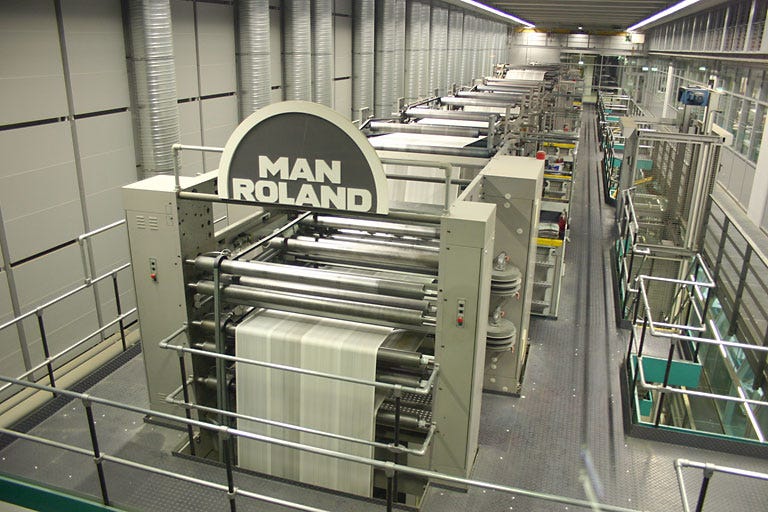
These machines were massive, and massively expensive to buy, maintain, and operate, multimillion-dollar, ongoing investments at a time when a million bucks still meant a heck of a lot. Paper ran through drums that had big, metal (eventually, in the late 80’s, plastic) sleeves that let fast-drying ink—dye, actually, in many cases, but that’s a whole other discussion—be printed accurately and at high speeds in some places but not others, which meant text and images on paper.
And if you didn’t own one, and weren’t able to get access to one? Tough. You couldn’t publish anything at anything remotely resembling volume, because your only other option was a mimeograph, which was more affordable to buy but so, so, so much slower. And, while it was a lot cheaper than an offset press, these things weren’t exactly cheap or easy to use, because you had to make new custom stencils, by hand, for every page you wanted to print.
Now, it needs to be noted for a moment here—the suppression of trans people in traditional publishing was very much part of a wider suppression of nonwhite, non-straight voices, and even nonmen, to a pretty significant degree. One of the most important projects of the ‘80’s was the creation of Kitchen Table: Women of Color Press, to push back against this suffocation, and it was one of very few presses that successfully produced queer books in that time, even though it’s main focus was more generally work created by women of color.
The massive investments you needed to make to enter the publishing industry changed in 1976, when IBM brought the IBM 3800 to market, the first commercial-grade laser copier that used regular paper. It required no special training to use, and was reasonably quick and accurate. Because it was still expensive as heck—it was room-sized, and cost $175,000 per unit which, inflation adjusted, is the equivalent of very nearly a million bucks at time of writing—it took some time for laser printing and copying to mature. By 1984, the first home laser printers hit the market, and improvements in laser technology had shrunk and cheapened commercial laser photocopiers to the point that a new cottage industry was thriving: print shops. Again, we have to acknowledge that “home” here was pretty much still a euphemism. Apple’s LaserWriter, for instance, was released in 1985 and was marketed as a low-cost home laser printing solution because it was the first printer that could be connected to several machines at the same time. It cost “only” $6,995 or, inflation-adjusted, about $21,000.
You can see why people didn’t line up to buy these things. But, for the same reasons, that became cost-effective pretty quickly for print shops, which could keep those printers in near-constant use. Printing at a nickel a page, it’d take 140,000 printed pages per unit for a print shop to break even, but that wasn’t especially hard. A lot of people found that the ability to print up ten or twenty flyers for their garage sale, their kid’s bat mitzvah, their Girl Scout cookie sales, for less than a buck to be an incredible bargain, and it really was.
And it’s here that we turn back to queer folks and Neo-Nazis. In the mid-80’s, old media gatekeepers were still very actively suppressing both groups, but little local copy shops, often owed by one person or a family, really didn’t have a stake in that fight. For the first time, a Neo-Nazi could quietly walk into a business, get hundreds or thousands of copies of a newsletter, and walk out—and all it took was for the owner to be neutral or sympathetic.
Or, you know, for one of the Neo-Nazis themselves to set up a copy shop of their own as a day job.
This allowed Neo-Nazis to finally find a way to get the word out again about their hate, and marked the beginning of the end of the ability for traditional media gatekeepers to suppress them.
At the same time, queer folks were breaking containment in the same way. The punk movement had really pioneered ‘zines in the late ‘70’s to a degree of success that small-print-run magazines had almost never enjoyed before, and there was a fair bit of overlap between the punk and queer communities, which found themselves increasingly aligned in opposition to Neo-Nazis. So, queer writers often adopted wholesale the homemade, cut-and-paste aesthetic of their punk brethren and started putting out their own stuff. Queer ‘zines flourished in the mid-to-late 1980’s, especially in big cities like New York and San Francisco, which had begun to liberalize on gay rights much more than many places in the U.S.
But it was the mid-’90’s where things really took off, for both groups.
The internet comes home
Four things happened within a two-year time period in the mid-’90’s which supercharged the dynamic that both queer folks and white supremacists had been emerging from underneath.
In early 1994, Yahoo, the first web guide was published online. Not yet a search engine, but rather a huge list of different websites, it was the beginning of search. It was followed quickly by AltaVista, the first search engine as we would recognize it today, allowing home users to find websites they didn’t already know the web addresses of.
At the end of 1995, Adobe PageMill was published. It was the first WYSIWYG web editor, meaning that a user no longer had to know any computer code at all—and up to this point, most people learned coding at university—to create a fully-functional and -featured website.
In April of 1995, the US government ended funding to the National Science Foundation Network, which had until that point restricted most internet use to government agencies and universities. Before then, it had mostly just been Usenet boards and direct connection between devices.
In late 1996, America Online changed its pricing model from an hourly rate to a flat monthly fee, effectively shifting its focus from libraries, businesses, and industry to residential service. It was the first web service that marketed itself to home users, and allowed people access to the internet outside of work or a university for, in many cases, the very first time.
Things exploded in the quietest way. For the first time, there was a place you could be queer and utterly anonymous, and queer folks flocked to the internet. TGForum.com, started just months before the internet was effectively privatized, became one such haven, and thanks to a late 1998 snapshot of the site preserved on CD-ROM, we can see just how badly trans people needed that anonymous connection.
But Neo-Nazis saw the same opportunities, and seized them. Within only a few years, at the turn of the millennium, white supremacists had used the internet to very effectively networks with each other as a series of loosely-connected cells and founding hundreds of websites to spew their hatred. They survived scrutiny from organizations like the FBI by, often, buying web hosting in far-flung corners of the world where there either wasn’t enough white supremacist activity for local law enforcement to take them seriously or in nations where, simply put, nobody cared.
There were a lot of places where these white supremacists metastasized to recruit, some of which you know—4chan is by far the most notorious, but there were many others—and a lot of them were places queer folks exploring their identities and, often, trying to repress them ended up too. Poorly- and unmoderated forums increasingly slid into white supremacist control, becoming sites of online aggression where reprehensible behavior was celebrated. More and more, the tense coexistence and regular conflict between deeply marginalized queer folks and white supremacists on these forums, each drawn to them for the same reasons, with white supremacists often masquerading as queer anons to push transmisogynistic ideas that persist far too commonly in trans culture to this day.
And, eventually, Gamergate happened—or, I should say, was manufactured. Seeing their chance to radicalize a bunch of disaffected, lonely white men, white supremacists leaped at the tempest-in-a-teapot that Gamergate started out as, and drummed it up louder and louder, using the manufactured outrage of these young white men as a way to turn their white supremacist rage into broader racist radicalization, a fault line they continue to exploit to this day to enormous success—membership in white supremacist groups hasn’t been so high since the 1970’s.
And, as is far too often forgotten, the original target of Gamergate was Zoë Quinn, who’s trans.
As it was, so it is
In some ways, it’s anticlimactic and a little weird to hear that trans folks and white supremacists are at the front lines of this fault line, this incendiary moment in U.S.—and in too many ways, world—history because we were suppressed in the same way as Neo-Nazis were for decades and found ways out of that suppression in the same places. And it’s why trans people—more loudly, at least, than any other minority—have become the first and most visible target of their hatred. In many ways, transphobia is now the beating heart of white supremacy, even more than racism, because trans people typically become unable to procreate in medical transition, making white trans people the greatest of “race traitors” in their framework and—worse to them—we violate their “natural” order of inborn gendered supremacy simply by transitioning.
But more, transphobia is an easier sell to non-radicalized people than overt racism is. Say to a "so-called “normie” that you want to deport all immigrants and most will stare at you, aghast, but if you instead say that you’re worried about fairness in women’s sports—a deliberate echo of their “ethics in games journalism” anthem that recruited so many to their cause—those same people won’t reject you out of hand.
Make no mistake: these people haven’t abandoned their racist rage and hate. They’ve really only stoked it, to be frank. This is a strategic move on their part, in the same way that vocal and forceful queer resistance to them is more than a principled stand on our part.
But the last piece of this puzzle that we need to face is deplatforming—where we come full circle to Substack and it’s notorious Nazi problem.
The loudest cry you’ll hear from online white supremacists isn’t about trans people or their racist horseshit, it’s about the supposed suppression of their “free speech” by deplatforming them. The very history of institutional gatekeeping that kept queer people out so effectively also kept them out, and they know very well that their whole operation falls apart if they get deplatformed—and we know that deplatforming works.
And it’s what they’re trying to do right back at queer folks, by labeling us as inherently sexual or pornographic, and seeking to ban everything they think is pornographic. Which is why even I, a boring, married, demisexual gal, am such a passionate defender of the right of adult content creators to do their thing. It’s not really my sorta thing, but that doesn’t really matter.
It’s a toehold for the Neo-Nazis, same as we are on another front of this moment. It’s the way they’re trying to go mainstream.
And it’s why we can’t stop fighting to get Nazis the hell off of Substack, and any other platform that allows them to exist. Just leaving lets them fester and recruit.
Author’s note: This article was adapted from a lecture I’ve been giving for some years on the history of printing technology and how it transformed communication for people on the fringes of society.
Very good article, although depressing. However, even more depressing is the fundamental change in US society. I live in a red county in a purple state. Since Trump came to office the first time I wad horrified to discover many of my friends, co-workers, and family were secretly racist. They are not secret about it now. Do they call themselves Nazis? No. Do they have similar beliefs? Absolutely. And with this belief is the belief that all queer people are somehow morally evil and should be silenced. We have all seen this in the US in the last decade. Now I would very much like to untie our weird connection to WCN, but since queer people are often more despised that WCN, I can't see how to keep people from platforming WCN and yet, platforming queer creators. Even though it is easy to say queer platforming is based on love, equality, etc, and WCN is based on hate, most will tar both WCN and queer journalism with the same brush. We are either both morally evil and should be banned or not, due to freedom of speech. Until the US gets far from capitalism, patriarchy, racism, vertical Christianity, and misogyny, which are all tied together, we will forever, stupidly, be tied together under Freedom of Speech. And for that, I am exhausted and sad. 🏳️🌈🏳️⚧️
"Enter lasers"
As an optics Ph.D., I'm contractually obligated to point out that everything is better with lasers.