
Plausible Deniability
Comics, Embodiment Fantasies and the Rhetorical Fetishization of Transness

Foreword: This presentation was delivered on 3/5/26 at the 2026 Conference on College Composition and Communication.
Content Warning: This article discusses kink and sex frankly, but in an entirely non-explicit way.
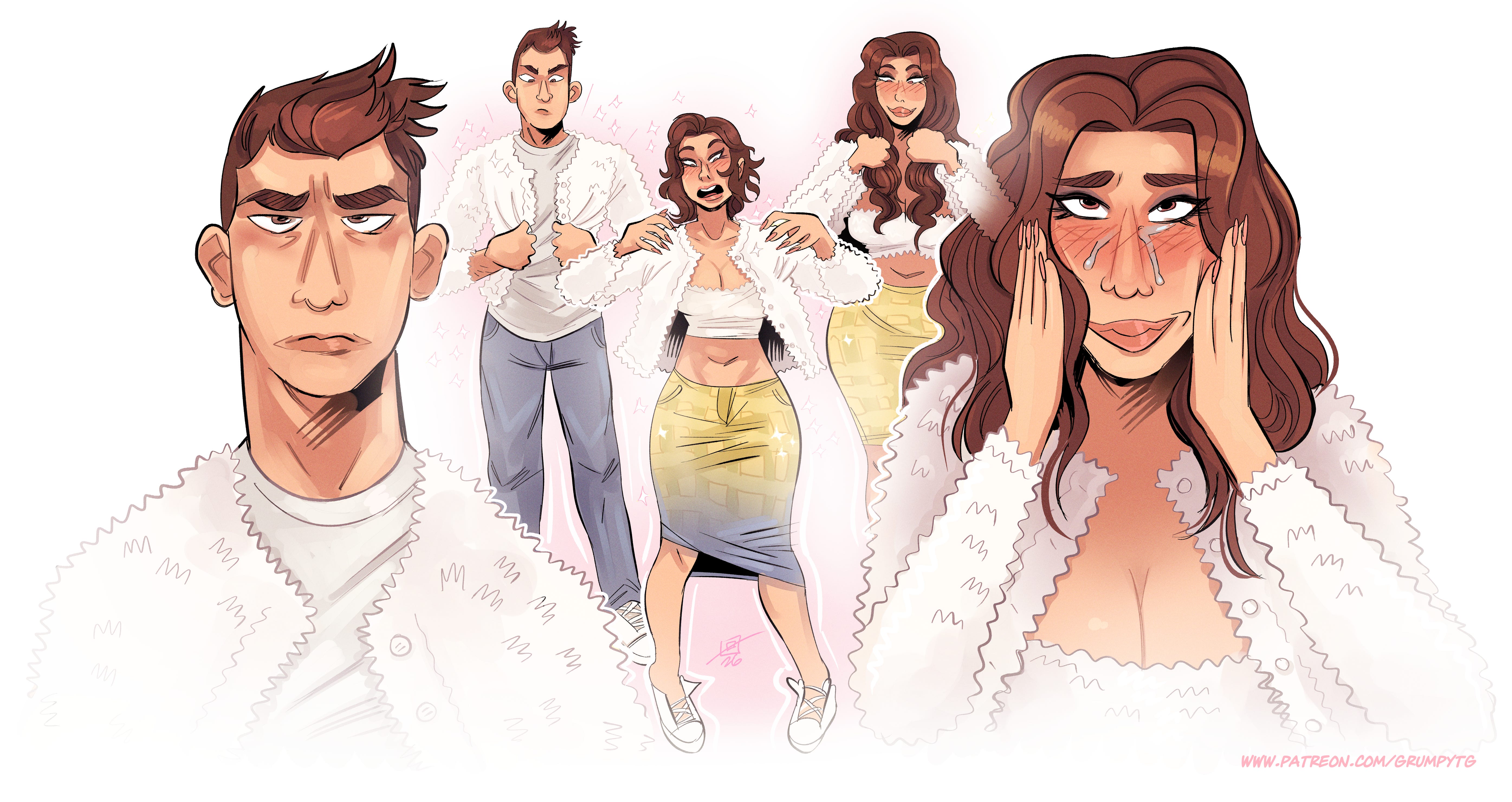
I want to open with a content warning: I’m going to be showing you some comics today, and while none of them are more suggestive than anything you’d see on a trip to the beach, all of them were created as a type of fetish pornography known as transformation kink. If you need to step outside, I understand, but there’s no way for me to explain what’s going on otherwise. Also, to make my positionality clear: I’m a white demisexual lesbian altersex trans woman; while I’ll be focusing on transfemininity today, I think that much of what I have to say applies to the transmasculine experience–I’m just not the right person to say so.
So, all that being said, let’s start with a couple of easy questions. Does this look like porn to you?
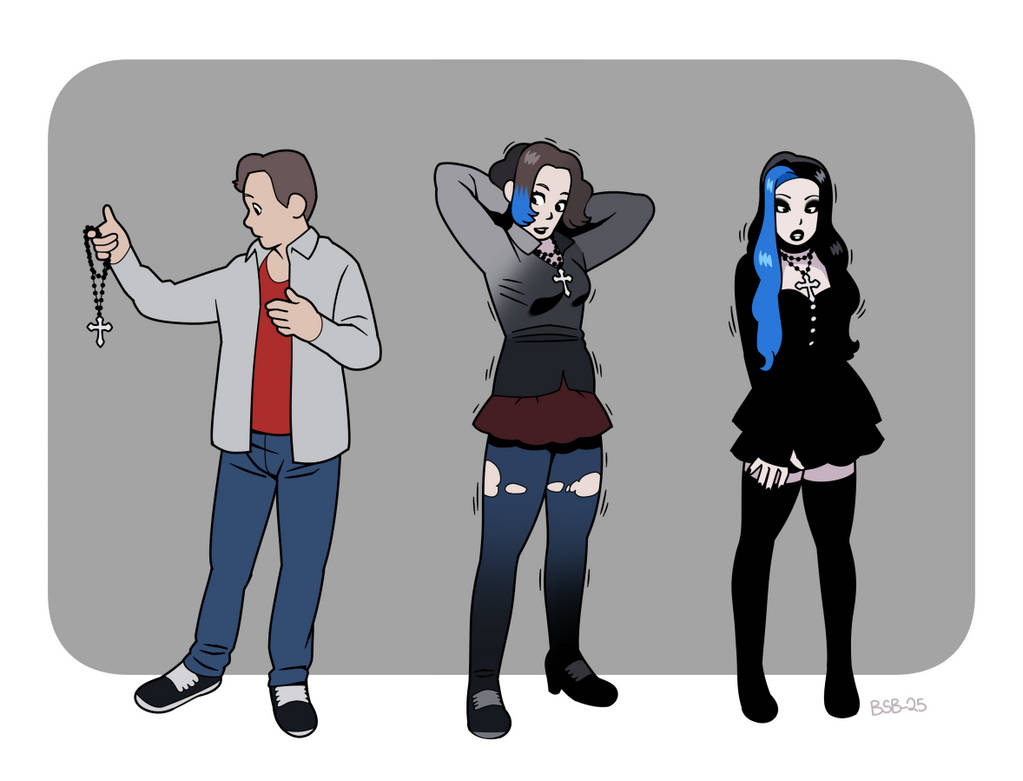
How about this?
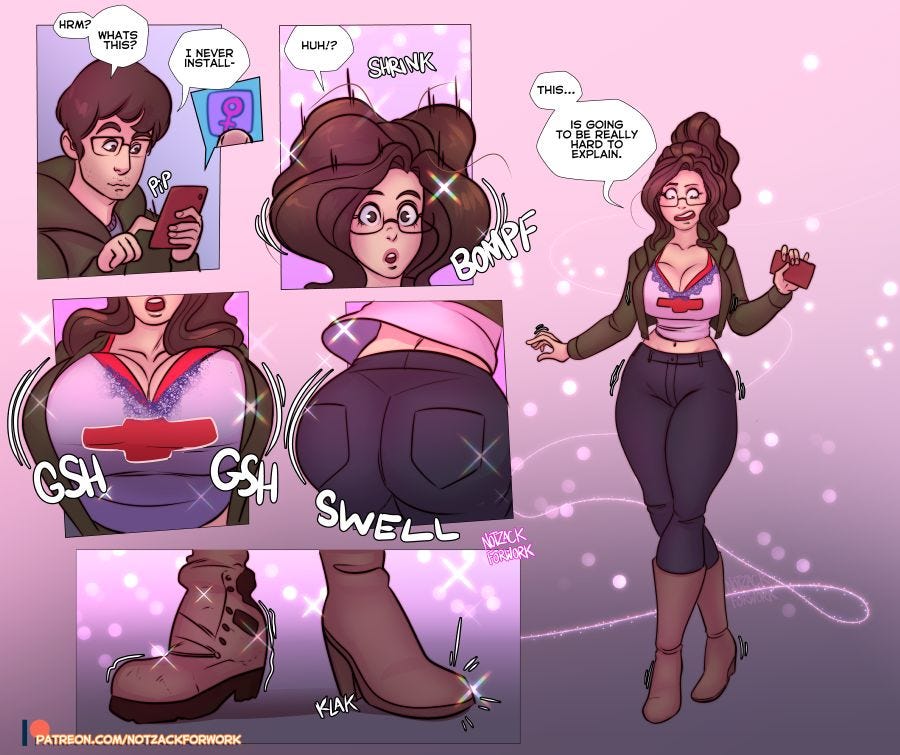
This?
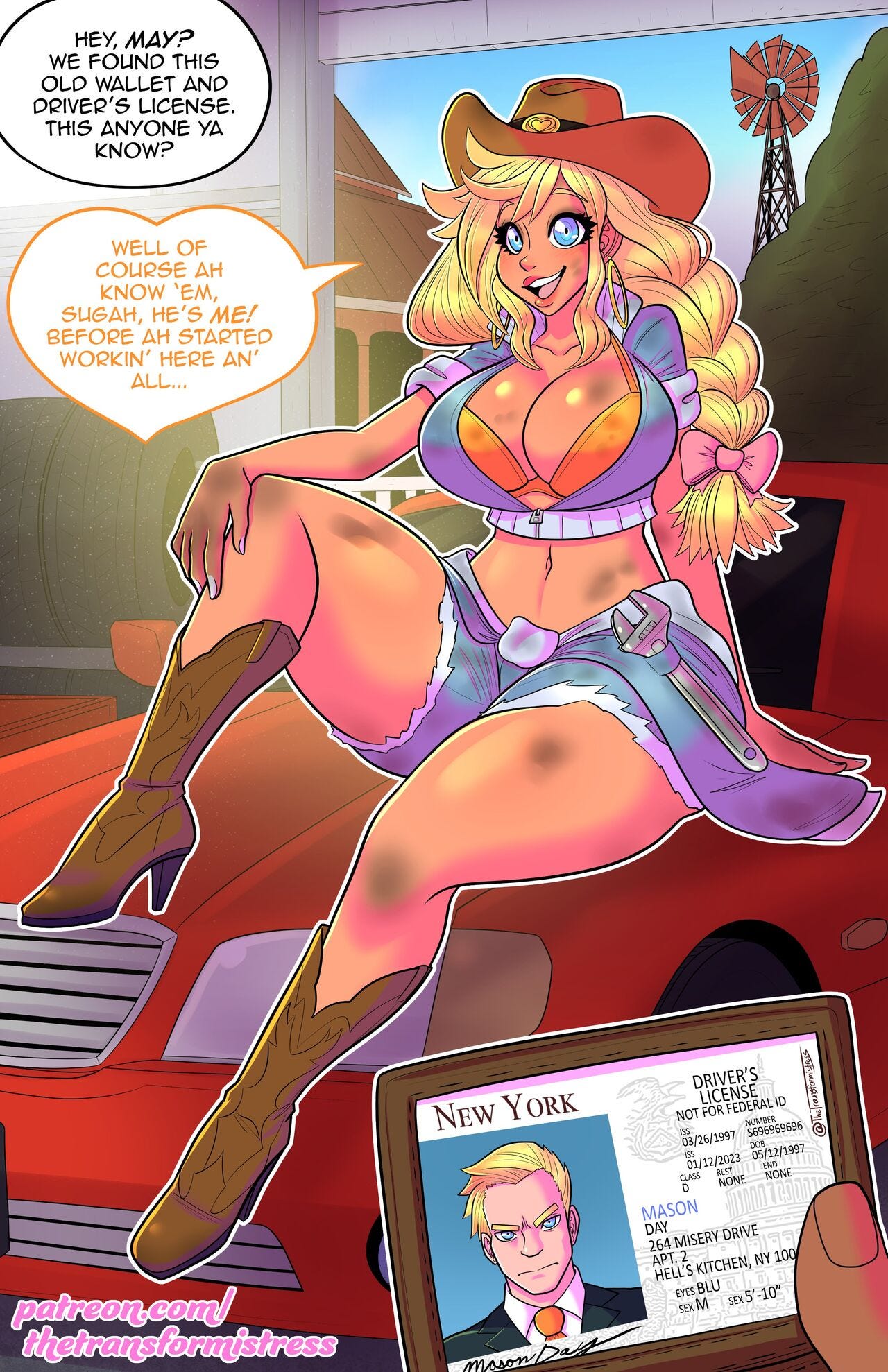
And how about this sequence?


I hear a few confused laughs out there, and believe me, I get it. None of these seem even remotely pornographic, do they? And, by any reasonable definition of porn, they’re just plain not. The thing is, though, all of these images were made by artists who not only specialize in transformation porn, they create it exclusively. The artists behind what we just saw–Blackshirtboy, NotZackForWork, The Transformistress, and Grumpy_TG, and I implore you to not search up their art on a work computer–not only create transformation porn, they all make a living doing it. And all of these images, except for the last, were commissions from their patrons or followers, commanding pricetags ranging between $200 and $300.
So, uhh… what, exactly, is going on here? Who pays hundreds of dollars to a fetish porn artist to get a commission of an unremarkable man, presumably the commissioner, turning into a fairly normal woman? I’ll grant that a couple of those girls have figures ranging from “impressive” to “deeply improbable,” but that’s just comics–look at Power Girl, for instance.
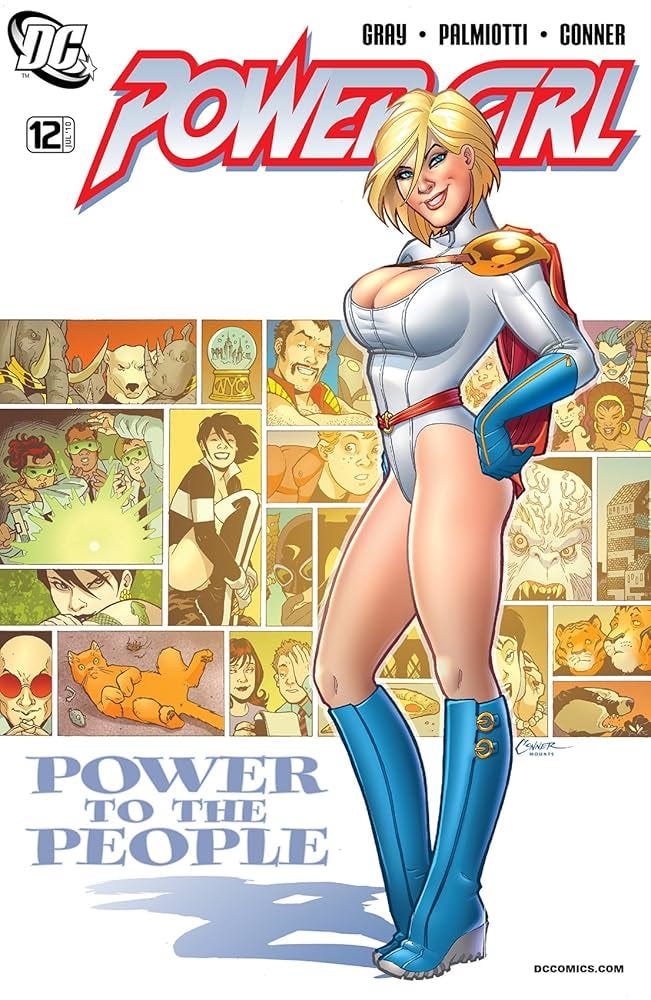
Oh, and those four artists? They also have one more important thing in common. They’re all transgender. And, as far as I’ve been able to determine, they all figured out that they were trans while–and sometimes because of the fact that they were making transformation porn.
Yeah. This rabbit-hole goes pretty deep.
Trans Comics
This presentation came from material left over from a book on trans comics that my coauthor, Jamie Garner, and I have been writing. In it, we explore the memetic rhetorical functions, as described by Sparby (2023), of three categories of trans comics: hatching comics, where a trans person realizes their identity, transition comics, where we work through the untold and unspoken realities of transition, and of what we call dreaming-comics, where trans artists try to imagine a better world into being.
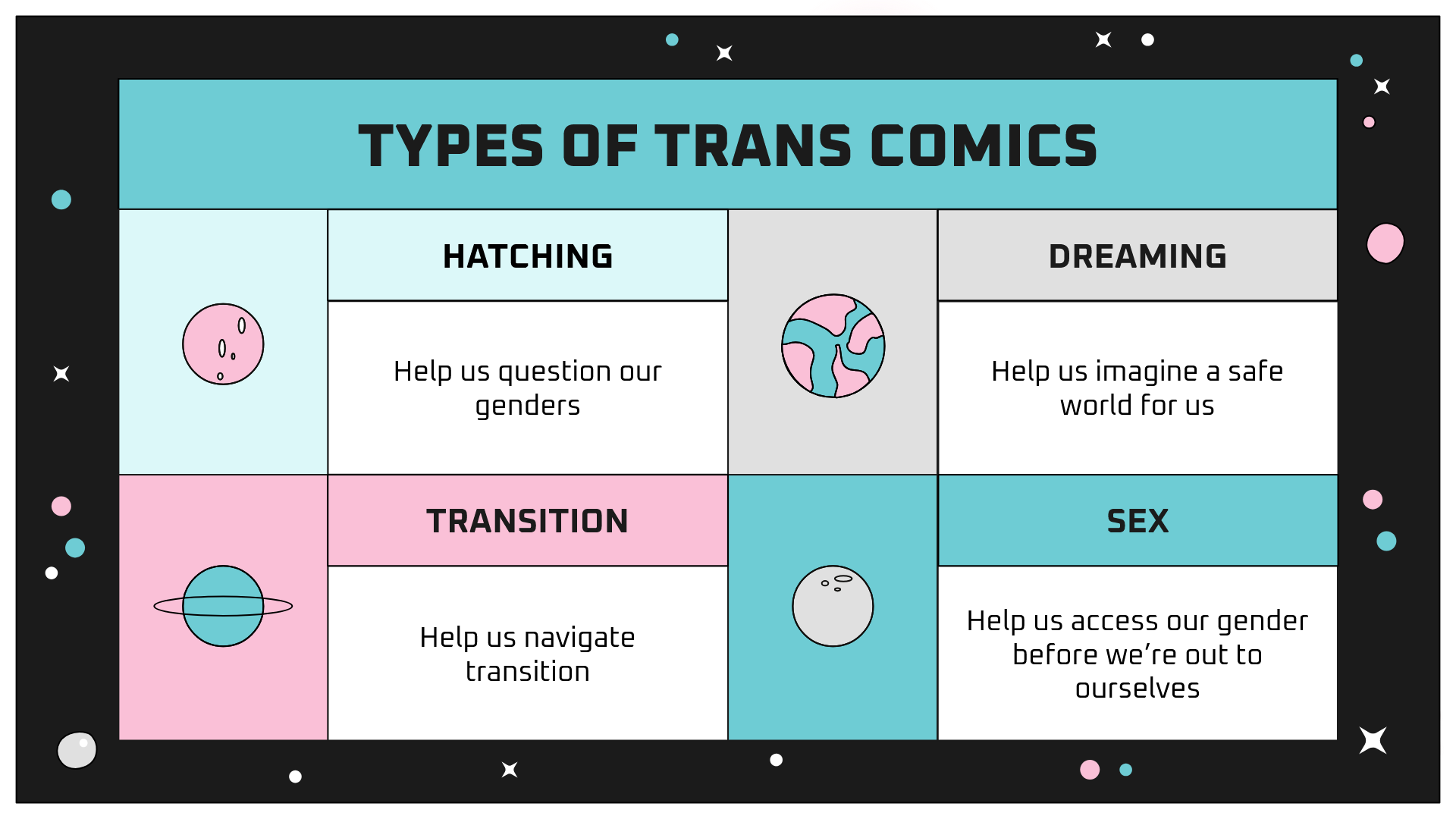
Now, the fourth category of trans comics–sex-comics–is one we left on the cutting-room floor for many reasons, but particularly for the safety of my coauthor, a trans woman who lives and works in Florida. All four types of comics use memetic rhetoric to transmit ideas from person to person in largely the same ways, and for the same reason–because the language trans people once had to understand our own gender diversity has been utterly obliterated over the last few hundred years as part of the global colonial project. Comics are an ideal response to this problem because their complex combination of words and text makes for a rhetorical whole far greater than either part by itself. Hatching-comics, transition-comics, and dreaming-comics collectively help us navigate transition as we all knuckle under to survive the active and ongoing genocide (Bragman 2026) currently being conducted against trans people in America, and to a lesser extent around the world.
But sex-comics stand out and are not only, perhaps, the most common of all four of these types of comics, they may be the most rhetorically important–but we have to go back in time to understand why, and explore the dark underbelly of psychology when we do.
The medical fetishization of transfemininity
When Harry Benjamin was introduced to Sally Barry in 1949, the western concept of transness began to be forged from the far broader substance of gender diversity. Gill-Peterson (2024) very rightly points out the violently reductive scope of colonial concepts of gender, but one part of this process needs specific attention: from that beginning and running until very recently, transness specifically and gender diversity generally were understood as fundamentally fetishistic. Obsessed with trans women for, probably, the same reason that Epstein’s crew were obsessed with us–because they wanted to perform fellatio while being profoundly homophobic–trans women were originally cast as gay men so gay and so bad at being men that we’d transition to access a better dating pool. It was not until 2001 that that model would even begin to be systematically discarded.
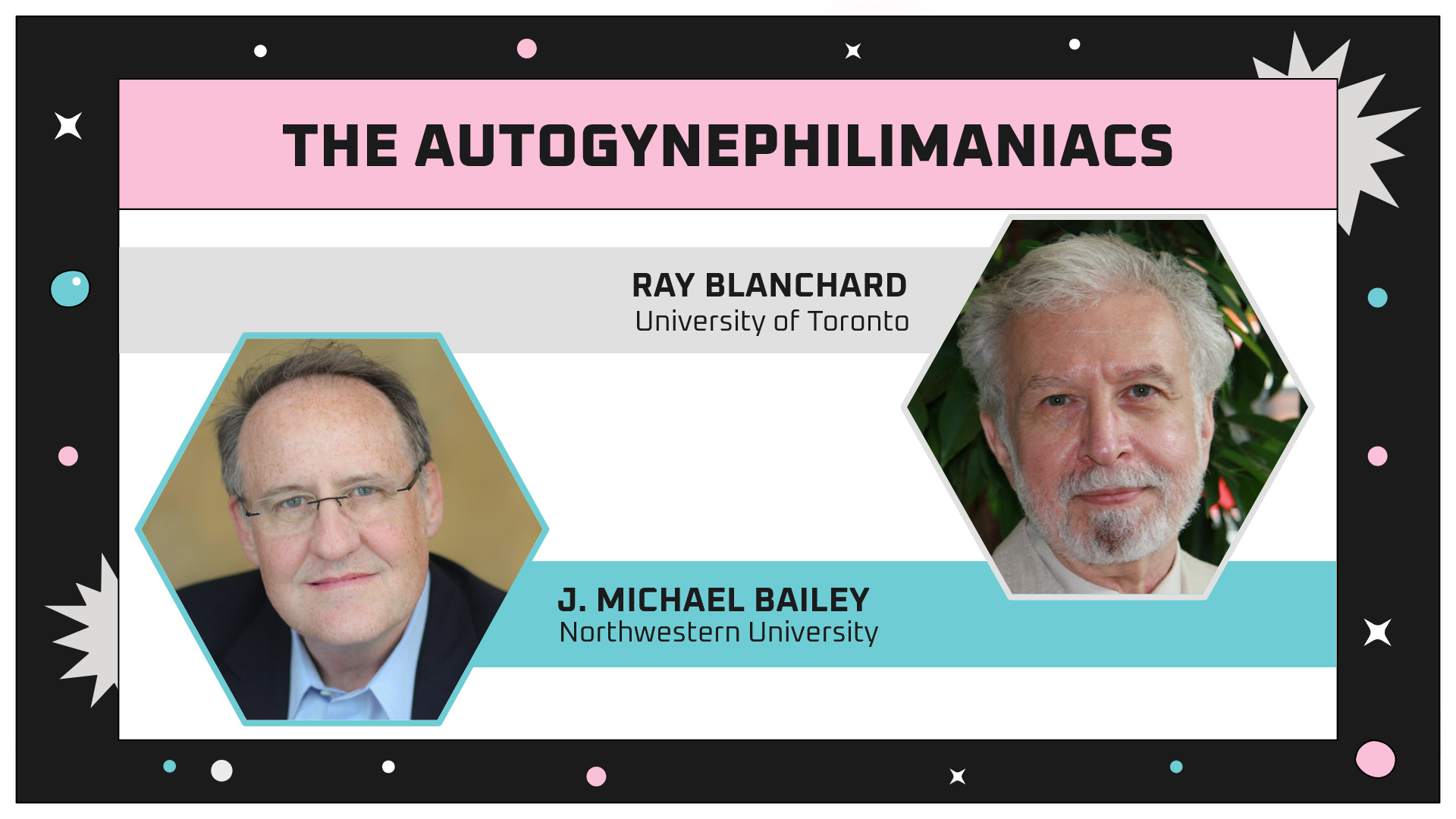
This psychosexual distortion was calcified as the concept of autogynephilia, or the sexual fetish of imagining one’s self as a woman, in 1989 by Ray Blanchard. It was further anchored over the decades by a number of other transphobic researchers, most prominently J. Michael Bailey in his 2003 book, The Man Who Would Be Queen. It should be noted here that both Blanchard and Bailey still practice, have been credibly accused of coercing sex from their trans study participants, and that Bailey is presently recruiting trans participants as young as 13 for a study in which he intends to ask them detailed questions about their sexuality. It should also be noted that the concept of autogynephilia has been overwhelmingly rejected by the scientific community, as the findings of Blanchard’s study have never been reproduced, and are now considered to be nothing more than typical embodiment fantasies (Serano 2019).
Despite this, trans women in particular have been commonly understood by the public at large to be sexual fetishists. This has many obvious impacts, but I want to point out one of the less obvious ones here: trans people who haven’t yet accepted their transness, or who are oblivious to it, very frequently imagine their feelings about their own repressed gender to be nothing more than autogynephilia–that exact, nonexistent fetish, run amok. It closets a massive number of us (Cox 2019), overwhelming us with shame at our own feelings, feelings which typically spill out in the bedroom. We psychologically sublimate them into a kink that allows us to touch and realize, for fleeting moments, our true genders without acknowledging the desperate need to realize them. After all, if “it’s just a fetish,” as many questioning people imagine, it doesn’t need to be acted on in any real way.
I described this psychological sublimation for the first time a little less than three years ago in the Stained Glass Woman article Beneath the Surface which, as of now, has about 170,000 unique reads and is by far my most-read work. Ever since, the thing I’m told most frequently by trans strangers is that that article is what made them realize that they were trans. And the most prominent rhetorical moment in it? A transformation kink comic, and a detailed deconstruction of how the transformation represents little more than a no-fault, no-guilt transition to exuberant femininity.
Grumpy_TG and A Little Bit Magic
Let’s get a little more specific.
Recently, I had the chance to interview one of the artists, Grumpy_TG, who made some of the art you saw earlier as part of this presentation. Grumpy is a major creator in the space, with almost 7,000 followers on Bluesky and almost 23,000 on Twitter at the time of writing; creating NSFW art is their full-time job. Now, to be clear, everything they make is porn, with the sole exception of A Little Bit Magic, the comic where these panels
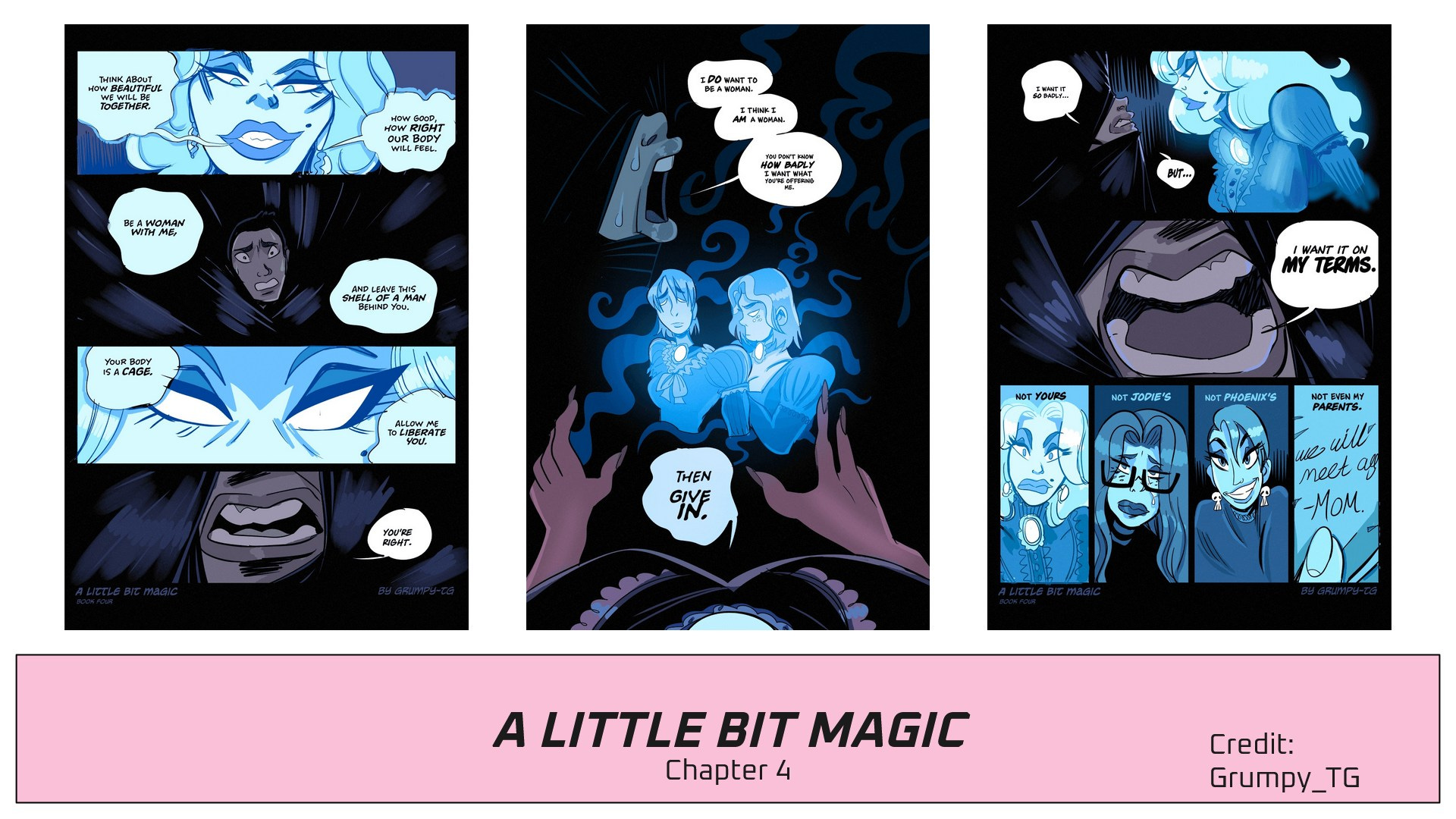
From earlier came from. Started in 2017 and completed in 2025, it’s a comic about a young man who gets a magically-refilling gender-changing potion who slowly comes to the realization that she was never a man. Also, there are demons and ghosts and school dances and a transmasculine character who literally splits into two bodies, one feminine and one masculine. You know, normal high school stuff.
And when Grumpy started writing it, they didn’t know they were trans.
Lucy, the comic’s protagonist, began as an author self-insert, and her journey to accepting herself as a woman paralleled Grumpy’s own exploration of their gender over the years. It wasn’t until about halfway through the comic, when Grumpy realized that they were nonbinary and that medical transition wasn’t for them, that their journey and Lucy’s split, setting the comic free to become a model to help trans people. The comic was deeply personal for Grumpy at every level, and as a free webcomic that never really did the numbers that their main-income art did, Grumpy noted that they probably would’ve abandoned A Little Bit Magic if it hadn’t been.
Despite all that churn, and all the emotional work behind it, Magic is what helped Grumpy understand, envision, and realize themselves. To quote them directly, “It’s strange that the comic didn’t take the same journey I did, but that’s comics; they help you figure out who you are.”
Grumpy isn’t alone either. The overwhelming majority of transformation kink artists are trans too, and story after story dribbles out about how they figured out their gender through their art. Some of them, like Blackshirtboy, even make comics about their journeys, and about the ways they fought, accepted, and became their own truest selves through their art.
And so, we return to the question we started with: why would someone pay hundreds of dollars to see themselves transformed into, frankly, mundane women?
Because it gives them plausible deniability, letting them look away from the truths of their gender and pretend it’s something it isn’t.
It lets them stay closeted.
Gendered desire, sexual desire
Comics, like all stories, are ultimately dreams caught on paper. They are uniquely rhetorical, because they can not only tell us impossible things, they can show us what those things might look like. In public, we all smile and acknowledge only the chastest of trans desires, for somehow sexless sexed bodies that match our souls. In reality, the most common thing questioning people wonder is “It’s just a fetish, right?” Spoiler: it never, ever is. Sexual desire is a fundamental part of the human experience, and yes, I say that as an asexual woman.
Desire.
It all comes back to desire, Ahmed’s (2006) gravitic pull of bodies toward bodies toward bodies, insuppressible by compulsory heterosexuality… or, to borrow from the work of Natalie Reed (2012), the mad assumption that all bodies, all people, are cisgender until conclusively proven otherwise. Cis, the default. Trans, the exception, when in reality there is no default. Queer desire has always been “arriving in the fleshy present” (Gill-Peterson, p. 153, 2024)--but wait, that’s Gill-Peterson–after all, “femininity is the reward, here and now,” because, “trans desire, the contact between trans bodies and stories, involves differences, which take shape through contact and are shaped by past contact with others” (Ahmed, p.100, 2006)--wait, no, that’s Ahmed again, and lesbian bodies, not trans, or is it the desire of trans lesbians for cis bodies of our own, or even the desire of cis lesbians for trans bodies–
It’s all tangled up. Gordian knot, but no bright blade to sever it. Ask me if I am, first, trans, or a lesbian, or asexual, a sexual asexual, and I can’t possibly answer. To me, being trans means being lesbian means being asexual, and for god’s sake, yes, a sexual asexual–that’s the Plight of the Transbian (Phipps 2023). Bodies drawn to bodies drawn to bodies drawing bodies that draw and dream possibility into existence where none could be otherwise.
The theory of queer desire assumes that the bodies people desire are cis and the bodies desiring them are too. It is there, in the very root and stem of our understanding of desire itself–that only cisgender bodies are desirable, and yet so many trans people first catch the dream of trans desires for trans bodies as a profoundly queered sexual desire (Phipps 2023). When you are trans, you cannot understand your gender without understanding your sexuality. That’s why 30% of us are gay, 30% of us bisexual, and 10% asexual. Why is it okay for me to be a lesbian because I am trans and not okay for me to be trans because I am a lesbian? It has to go both ways.
And it is through queer sexual desire that so many of us are able to discover, understand, and embody our gender, and for that we are made to bear a terrible burden of shame. If queer desire describes that gravitic pull of queer bodies to other queer bodies (Ahmed 2006), then it must also describe the desire to be trans, to transition, to paradoxically become a gender we’ve always been. We think of queer desire as fundamentally shaping what it means to be gay, and it does–it shapes queer desire to be trans in the exact same way.
And if there is no shame in finding your gayness, your lesbian heart, your bisexual disaster, in and through your sexual desire, then there should be no shame in trans people first glimpsing the dancing ephemera of our genders–yes, our genders, that means me too–in the dancing paper dreams of the erotic.
Afterword: Stained Glass Woman will be going back on break for a while after this article. Gotta finish up revisions on my scholarly book! For updates about when I’ll be back, check my Bluesky, @impossiblephd.bsky.social, or Mastodon, @Impossible_PhD.hachyderm.io!
Works Cited
Ahmed, S (2006). Queer Phenomenology: Orientations, Objects, Others. Duke UP.
Bragman, W. (2026). Experts Warn U.S. in Early Stages of Genocide Against Trans Americans. The Lemkin Institute.
Cox, M. B. (2019). Working Closets: Mapping Queer Professional Discourses and Why Professional Communication Studies Need Queer Rhetorics. Journal of Business and Technical Communication, 33(1), 1–25.
Gill-Peterson, J. (2024). A Short History of Trans Misogyny.. Verso.
Holmes, Andrew Gary Darwin. “Researcher Positionality - A Consideration of Its Influence and Place in Qualitative Research - A New Researcher Guide.” Shanlax International Journal of Education, vol. 8, no. 4, 2020, pp. 1-10.
Jones, N. N. (2016). The Technical Communicator as Advocate: Integrating a Social Justice Approach in Technical Communication. Journal of Technical Writing and Communication, 46(3), 342-361.
Phipps, K (2023). Plight of the Transbian. Medium.
Reed, N (2012). The Null HypotheCis. Freethoughtblogs.
Serano, J. (2020). Autogynephilia: A scientific review, feminist analysis, and alternative ‘embodiment fantasies’ model. The Sociological Review, 68(4), 763–778
Sparby, D (2023). Memetic Rhetorics. University of Michigan Press.
This hits so wonderfully well.
I'm a woman of trans experience, I am also a lesbian, and I labored under the autogynophilia bullshit for well over a decade. I absolutely thought I was a fetishistic little pervert. It took me 3 years from the time that I realized I might be trans to the time that I actually transitioned to work all of this out.
I could go on for days about how I had to deconstruct and dismantle the ingrained fetishistic transphobic and homophobic attitudes I was holding.
Thank you for writing this. I hope that this can help other people who are currently facing the same questions I had.
Happy three years of "oh shit I might be trans" to me, and good luck/congrats on the talk, Doc. The funny thing is I've been following your work (and doing my own digging) long enough that nothing here is really earth shattering to me. However, I suspect I am the exception (and most people don't follow you much less with notifications on), and this synthesis and connection is a valuable contribution to the larger literature. 💜