
Panel Lines
On being altersex, some assembly required

Foreword: This is not a typical Stained Glass Woman article.
While it talks about a few identities that are much more common among trans people than they are in the general public, it is not, directly, about anything to do with being trans. It also lacks much of the base in research that Stained Glass Woman typically includes, because there has been little or no research done on the things this article will talk about.

I’m half-reclined on the soft black leather of M—’s couch, feet up even in my boots. When it’s not the winter, I take my shoes off first, but it’s cold and some part of me loves the pure vibes of a patient reclining on a chaise lounge while they Do Therapy, wise therapist offering interjections from time to time. It’s an affectation of mine, one I like, but I also need to see her face while I unload myself.
It’s therapy, and I’m autistic the kind of person who needs to see faces to make sure I haven’t said something wrong.
Nothing unusual about that.
Plenty of folks like that out there. The world’s a big place.
—I’m alone, so fucking alone. A whole elementary school, and I’m alone, because the only times I’m not alone I’m attacked, relentlessly. I don’t have a single friend in this godforsaken place, the teachers don’t even try to protect me anymore, and despite the fact that I’m a fifth grader now, even the first-graders harass me because I’m profoundly weird, the kid that doesn’t make sense to anyone, the broken one, the queer (nobody knows, myself least of all), not really human, the one that must be cast out, the—
M— is a strange combination of kind and sharp, soft and strong, like a blade clothed in velvet. She’s good for me because I’m autistic and queer smart, I rationalize my feelings to avoid them, and if I’m not called on that absolute bullshit, I won’t process my own emotions. That’s the main thing I need from therapy anymore, now that I’m years past the endpoint of my transition: help processing my emotions and managing stress because I’m autistic. It’s the end of the semester, and that’s always, always a bad time for me, as the slow logjam of emotions I’ve bottled up over the last three and a half months come flooding out with interest, demanding their time in the sun whether it’s convenient to me or not.
This semester has been worse than most. Life in a collapsing empire as someone who the government wants to exterminate on multiple fronts, I guess. I’m a compressed hurricane inside, and have been for most of the week.
We’ve been wandering through the background radiation of the week’s stresses, of the bottled-up feelings and parts of my self that’ve been clamoring for attention.
“So,” M— says, “Talk to me about the altersex stuff.”
We skate across the basics. It’s not really new to her; I figured out that I was altersex almost four years ago, now, though I hadn’t found the word for it yet. That came months later.
Altersex (noun): Having or desiring to have a combination of primary and/or secondary sex characteristics which are not naturally-occurring. While this can include atypical genital statuses, such as those who are Salmacian, or those who want genitals which are entirely outside the scope of human contexts, it does not require them, and may instead refer to combinations of skin, chest statuses, body hair or the lack thereof, and so forth which are generally impossible for a human body to produce either individually or in combination.
I’m storming inside. I brought being altersex up because I need help, because I’m helpless in what it means to me as a person. It’s an outside context problem, except I’m the part that’s out of context. Addressing what it means to be me would require a world fundamentally unlike what it is now.
But the texture of my skin has been driving me wild for days now.
“I—” I search for words. It’s not usually this bad. I shift my hands, so they only touch the soft, blue plaid wool of my skirt. “My skin is too rough.” I finally say, and they’re not the right words. My skin is softer than it’s ever been, despite the winter dryness.
The problem isn’t that my skin is rough. My problem is that my skin is skin. That it’s not a combination of metals and hard and soft plastics manufactured. Artificial.
I try to explain this to M—. It’s like trying to explain what dysphoria feels like to a cis person. They don’t even have the frame of reference to begin to understand.
“I feel like a madwoman saying these things, even to you.” The sentence is out of my mouth before I can consider it. My autism must be raging control must be slipping, and envy twists in the hurricane inside me. I saw a picture yesterday, a convention of people not-quite-like-me. A quirky subgroup, close enough that we’d metaphorically brush shoulders in passing, but not one to which, it turns out, I belong. Hundreds of these people, crammed into a room, all together. It left my soul gasping for a community I will never know.
M— smiles her kind smile and shakes her head, oblivious to or not addressing the roil of emotions I’m fighting to keep inside of me.
“Tell me when you first felt these things,” she says
I’m twelve, in the summer of the worst growth spurt of my life, and the small comforts of the quiet normalcy of my body are being shattered, one by one, by the implacable hammer of puberty. I’m so isolated, so alone, that getting dragged out to Denver for the summer is no meaningful hardship for me; I have no friends to leave behind. I can be alone at home or alone here. The only real companions I’ve ever had are books, by the mountain.
But here, today, is special.
Today, we’re at The Tattered Cover, a five-story temple of a bookstore the size of a whole city block. Over twelve thousand square feet of books, of types of books I’ve never imagined.
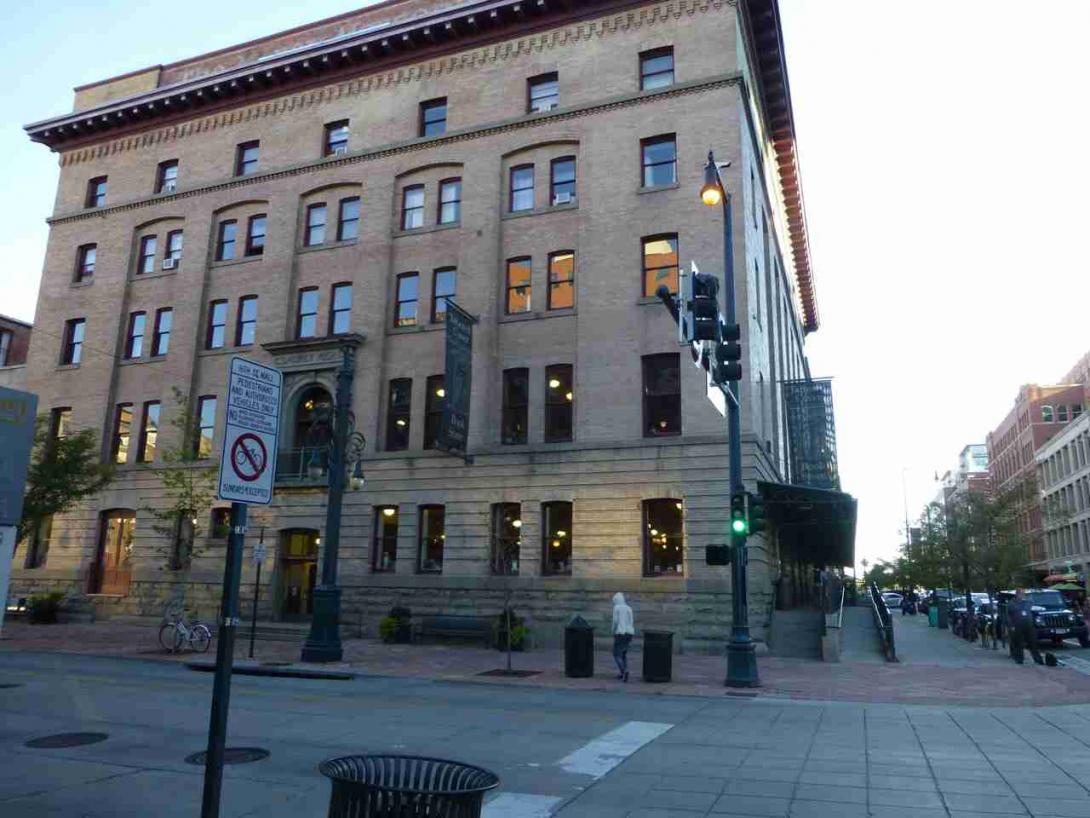
I’m curled into a corner chair in between the second and third floors. The third floor is where they keep manga, and while I’d gone there to look for Ranma 1/2, I’d found something different. Something even better. The cover of the book shows a cyborg girl with angel wings and big hair, falling to pieces. Battle Angel Alita.

The story is dark, a dystopian future where the only law is the bounties cashed in at the end of a rocket-propelled sledgehammer or the stellar fire of magnetically-contained plasma jets. But as much as I like the story, it’s not the real draw for me.
No. The real draw for me is Alita herself, the titular cyborg, found in a trash heap as nothing more than a cybernetic head and shoulders. When she gets a body—a real body, one that reshapes itself to the form she ought to have, sloughing of masculinity and size as if they were nothing whatsoever, I’m utterly hooked. She’s tiny, relentlessly feminine, and unspeakably badass.
I am far beyond entranced.
“Eleven? Twelve?” I say, the memory as sharp as it’s context was fuzzy. My memory for childhood things is unreliable. More memories burble up, other media, other feminine figures, machines-in-human-form. “As far back as I can go. It’s always been there, in places,” I revise myself. M— knows what that means, understands how fragmented my memory of childhood things is. Shining shards of colored glass, floating in an ocean of indistinct silica dust.
Memory is fundamentally unreliable. For me more than most.
We talk some more.
“What would you want your body to look like?” she asks eventually, and the hurricane inside me tightens, spins faster.
—indistinct dreams of small limbs, a compact frame. Gleaming, reflective chrome and red and bright titanium white. Shards and pieces, ideas cobbled together from a hundred sources, none of them right none of them me, none of them—
“It’s not aesthetics,” I say, banishing the flash of feeling and thought as best I can. “It’s not a looks thing, M—.”
“What is it then?” she asks. Not challenging, just, not understanding.
“It’s being,” I say, stressing it as much as I can. “It’s like with my boobs. It’s not about how they look in a mirror or how other people see them. It’s about how they feel, about being embodied in the right way.”
These words are correct and true.
These words are laughably, pathetically false. They imitate the truth, perverting it like shadows on the wall of Plato’s cave.
—the sound of dozens and dozens of tiny articulated plates, sliding over each other on impossibly-small rails as the hard chassis of a body flexes and moves in ways that flesh and muscle stretch to accommodate, but which hard things could never manage. They click into place, one after another, the sound as right as their presence, a tiny, tinny orchestra of mechanical perfection, tikka-takka-tak, each component loved and maintained and perfect in its place—
The hurricane of feeling inside me is spinning tighter and tighter. I endure.
Therapy hurts sometimes. That’s just how it goes. You have to hurt to heal.
“Well, what would your perfect body be, then?” M— recalibrates. I try to not wince. This is better-phrased, can pierce to a deeper truth I don’t know if I can properly share.
“What are we talking about here?” I deflect with a question. “Like, body composition, mechanics, appearance?” I’m trying to impress upon her the impossible, interdependent complexity of it all, technology that we can barely imagine.
I’ve only ever talked about being altersex online, and only quietly. It’s not that I don’t want to talk, it’s that I have to explain it all, every goddamned time, over and over again, to people who simply cannot understand what it is that I feel. “I want a prosthetic body,” I tell them, “like Ghost in the Shell.”
This is wrong in every single detail. I say it anyway. They never even have a frame of reference to understand without the pop culture reference.
I am so fucking tired of dog-walking people through an experience I can barely even piece together myself. An experience I can’t truly piece together myself, if I’m really, deeply honest with myself.
“Let’s start with appearance,” she says, piercing my deflection as she always does, as I thank her over and over for doing. “What would it look like? How would it move?”
“I—” Ohhhh, this is the wrong question, I can already tell. The right one that needs to be asked and answered, but wrong, so wrong, wrong for the moment I’m in. The hurricane rises, fast and harsh and angry and fierce, because how I want my that body to move is the very heart of what would make it different and right. “Legs and arms like the illustration I showed you,” I begin, holding myself together, then bite into the pain, fighting to endure and push through. “Panels, a combination of hard and soft plastics.” I can’t say the rest—artistic contrasts of red and white, gleaming liquid and glossy even in lowered light.
“Near-human. Human-shaped,” I say instead. “But not. Not quite.”
—not at all not at all not at all not at all not at all not at all—
“Detailed articulation,” I continue, or try. Tears are rising, and the pain of longing I try to ignore in my chest is physical, a blade of truth M— and I have crafted together that pierces me through in the cruel face of the impossibility of what I wish I could be. “Along the flanks and especially the clavicle, so that when I move, they move and slide over and through each other—”
I can’t continue.
I physically cannot continue speaking.
I’m pinned like a butterfly, run through with the gleaming chrome-steel of that which I may never, ever have, ill-defined bits and pieces of a body I know I need want and which I can only hold in my head one at a time because if I try to picture the whole of my the body, the pieces out of isolation and into a gestalt whole, the pain of its absence is too much to bear.
I writhe on the couch, curling into myself as I choke back sobs. The heart of me screams in a pain of longing so intense its physical, lancing, inescapable.
“Can we not do this today?” I bite out.
“Of course, I’m so sorry,” M— says, tone between my her surprise and worry. “I didn’t understand—”
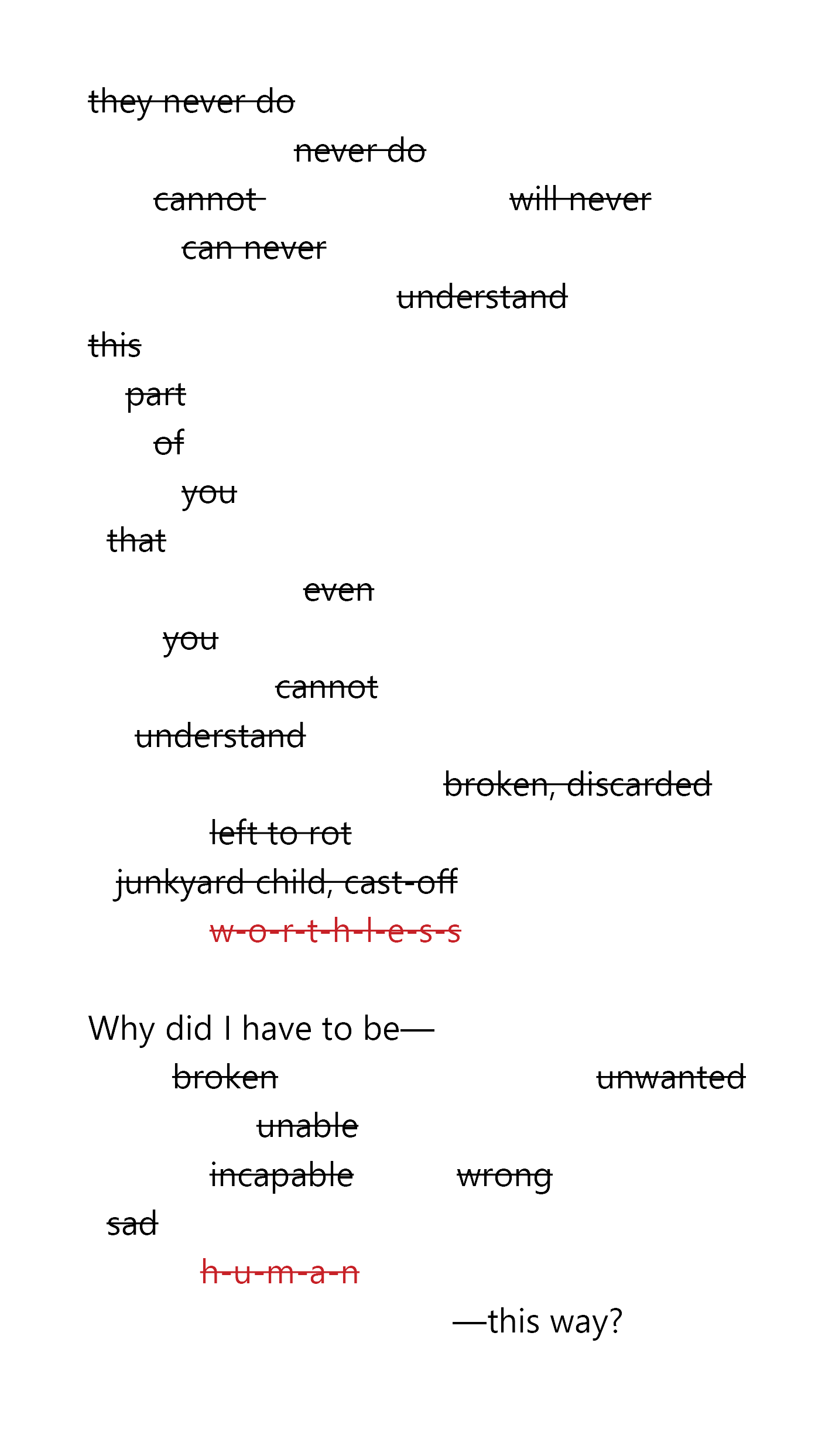
so
alone
i have never knowingly talked in person to another altersex person about being altersex
let alone someone
who is altersex
the
way
i
am
and i will never, ever be able to have the body that will heal these hurts.
Other selves
Have you noticed just how many trans people are—well, name your subgroup. Neurodivergent. A furry. Plural. Bi, ace, gay. Disabled. Any number of other things. All these little adjectives, microlabels, tweaks of identity that describe who we are in more detail, so that we can be understood.
So that we can find community.
To fight desperately to find within ourselves a treasure with value beyond compare.
Authenticity.
Ourselves.
When you look at the research data about these identities, you see trans people popping up at heightened rates all over the place. We’re six times more likely to be autistic than the cis background rate. We’re far more likely to be gay, ace, bi, or pansexual than cis folks, by massive margins. But why? Are trans people just… weird? Does having these other identities make someone more likely to be trans?
Frankly, in all likelihood, the answer is no. Over 20% of all Gen Z women are bisexual, a number that’s very close to the rate at which trans people are bi. The stigma for being bi, if you’re a woman, has largely disintegrated for young folks these days, so people are discovering and owning these parts of themselves rather than burying them, the way earlier generations did.
The same is true for trans folks—just not because the stigma is gone.
If you’re trans and out, that’s the biggest queer stigma you could possibly take into yourself. Being bisexual, or gay? Drop in the bucket, by comparison. Who really cares? Autistic? Hell, you’re already alienated from a society society that considers you monstrous. Being alienated for two reasons isn’t that much different.
Coming out as trans, transitioning, whatever that means for you—this is something that’s ultimately about digging deep inside yourself in search of true, deep authenticity.... and authenticity is truly an all-or-nothing proposition. That’s the blessing and the curse of being trans: you learn, very very well, how to dig deep inside of yourself. How essential it is to shove that spade into the rancid, polluted earth of The Way Things Ought To Be that you’ve been buried under your whole life and throw it aside, stroke, by stroke, until you discover, deep down, this deep-buried aspect your true self and excavate it for all to see.
And once you start, you can't stop.
Being autistic, bisexual, gay, a furry—altersex—these are other buried parts of your self, no more or less. Trans folks just find them more often because, so to speak, we have more practice digging, and know how to use a shovel more effectively.
These things are not trans. They’re nothing to do with being trans.
They just… intersect with it, at odd angles.
People are messy, right?
this article is an attempt and a failure to make stained glass
stained glass is not kintsugi
kintsugi repairs what is broken, honoring and highlighting the breaks and the mending
stained glass is about using broken shards of glass to make something completely new
and the thing about stained glass is that there will always be some shards
that
do
not
fit
anywhere
normally, they throw those shards away when they can’t be used or melt them down
but when you’re a stained glass woman that’s not an option
unless you want to throw away
-y-o-u-r-s-e-l-f-
these are the shards of me that i cannot make fit
either me
or each other
Altersex
I’m not going to tell you the details of what makes me altersex, any further than I already have. It’s none of your business. The skin part is enough to qualify, but there is more. I will not peel my oh-so-wrong flesh back to show you the glistening, quivering meat of what I wish I were, to show people an intimacy of self not very different from when a cis person asks a trans person what’s in their pants. Which, frankly, is often what’s literally involved when a perisex person asks what makes an altersex person altersex.
I refuse to be a spectacle for gawping.
We use “altersex” as a word for ourselves because we’re decidedly not intersex. Those folks have their own oppressions, their own struggles, and their own self-actualizations which are not ours, which we have absolutely no right to step into and claim as our own experience. And as intersex people so often, and so rightly, say: many, perhaps most, intersex people are cis. Theirs is not a trans experience, regardless of whether or not some of them are trans, in the same way that being bisexual is not a trans experience. They intersect transness at points—maybe more often than they do other identities—but their identities are not ours to lay claim to.
Being altersex is also not necessarily a trans thing, though most of us seem to be right now. No greater proof is needed than, if you hang out in Salmacian spaces for any length of time, cis men and women will drift in from time to time, needing the same bottom surgeries that trans Salmacians need, but remaining confident and comfortable in their genders assigned at birth. It’s probably just that most cis people haven’t even imagined that living an altersex life as their own gender is even possible, so they don’t even go looking.
Even the term, altersex was coined just ten short years ago, and it didn’t come from queer folks trying to find words for ourselves. It wasn’t people like me, deliberately trying to make space for intersex people, though we have tried our best to do so.
No. It came from a fight about smut.
And way too many people still use altersex—as a term, not an identity—to be shitty and transphobic or intersexphobic, because they like to fetishize people with both breasts and a penis. But then, if you’ve seen, like, just about any porn ever, you already know that, don’t you?
Imagine, having an identity that’s central to your being. Imagine the term, and the necessity for that term, came directly from porn, and not people like you. From people who wanted to fantasize about bodies not that they longed to have, but so that they could sexually exploit them. Not because you or people like you were grasping for a way to describe the hidden corners of your soul. Because people were being shitty, and wanted something exotic to jack off to.
Imagine how that must feel, to know it, to live it, every minute of every day.
My feelings, this part of me, this screaming thing inside of me I try to ignore when I can—it predates any of this by decades. It traces to a time when there were no words for whatever-it-is that I am, when dreaming a body for myself into reality was, if anything, even more impossible than it is now. It’s the “Ancient Greeks didn’t see blue” problem all over again. Linguistic relativity is a fucking bitch.
Like any other way of being, it’s probably an odd artifact of some part of human psychological evolution that we don’t understand right now, but there’s no research on the matter. And I mean that very literally. As far as the research literature is concerned, people like me do not exist.

Bridging feelings and science is what Stained Glass Woman is ultimately all about. Understanding how the essential, radiant pieces of self that drive us to transition, to self-actualization—how the feelings that make us human—connect to what is measurable and testable in the world writ large. But we cannot measure what we cannot name.
And what we cannot name does not exist.
Representation(less)
Representation is how we dream a better future into reality for ourselves. It’s how many of us figured out that we were trans during the COVID lockdowns, for instance, and I’m definitely among that group. I exist as I am now because a bunch of brave people had the courage to stand up and tell the world, “Here I am. This is what it means to be trans. What people have told you is wrong.” This effect cuts across every demographic—Black folks, women, sexual minorities, disabled folks, all of us need to see someone like us doing or being a thing to begin to imagine ourselves doing or being it. That representation is an important part of why Stained Glass Woman exists.
As I’ve explored and come to terms with my altersex identity, I’ve met other altersex people along the way. Very few are like me. Most are Salmacians, and they’re the group of altersex people who’ve gotten the most visibility and the most attention—but that’s a statement with an asterisk the size of Saturn trailing after it. They’ve fought to be listened to, to be seen, by a medical profession that, until very recently, saw them not just as aberrant, but as monstrous.
With enormous effort, they’re beginning to overcome that, and they’re beginning to tell their stories. Hyde Goltz, possibly the first post-op Salmacian (and if not the first, one of the first) created a beautiful little illustrated ‘zine about it called Bigenital Revolution, and it’s really, really worth your time if you’re curious about the Salmacian experience, want to learn more about altersex people… or especially if the idea of having both a penis and a vagina calls out to you from a deep place inside of you.
But what do you do when there is no representation?
And I mean none none.
Most ways of being altersex are speculative at best. Like, for me? It is absolutely impossible for me to ever have a body that speaks to my heart the way Hyde’s speaks to theirs. There is no representation for me because that part of myself that I’ve unearthed from deep inside me cannot exist in the real world. Not now. Maybe not for hundreds of years.
How can I dream a self into being when she can’t exist? Flapping in the wind, a flag torn to ribbons by the shifting, impossible winds of a world that simply does not care. Tattered, but hanging on, because what else is there?
I’ve searched so wide, so deep, for anything to latch on to that might let me be myself, in this way, a little more completely. Just to name one, I spent months combing through furry identities and sub-identities, hoping there might be something there but—no. Transhumanism is no better, even posthumanism, as they sit in cushy easy chairs and idly speculate about what could be, what might be, what they wish could be. No urgency, really, and what excitement there is is purely intellectual, without any feelings. Star Trek dreaming up PADDs that might become tablet computers someday.
No feeling except what if…?
And then, the only other place people like me exist. The places, the websites, the ideas you can’t bring up on a work computer. You know the ones. Need want shiny skin? Fetish site. Fetishist. Sex creep.
Disgusting.
The only places you can get these things only make them for one purpose, and that purpose shows up in their designs. Is unmistakable, really. All feeling, all gut, all— Well, you know what goes there. Maybe that feeling doesn’t grate so badly at people who aren’t asexual, but I am, and it does.
Every place, every idea, every way I’ve ever looked— it felt more alienating than just living the way I am now. I don’t want an alternate me, with a mythos and a new shape to express a part of who I am. I don’t want to be the subject of intellectual curiosity or fuck-meat lust.
I just want to be. I want a me-me, not another-me, a different-me, just not this-me.
Words fail—
How do I tell you that the shape of my body is pretty much right, and that’s what’s wrong is what it’s made of and how it moves? How do I tell you that I want you to be able to see at a glance that I’m not human. A person, but not— ugh, even the phrasing implies that such a thing would be demeaning, a horrendous loss of self and autonomy and worthiness. What I want is coequal, but different, and there’s no word for a human-shaped thing that’s actually separate and equal. Our language and culture both reject the premise on its face.
How do I say these things in a way that you can even remotely understand?
How can I explain a thing to you when the words to describe it do not exist? And the words to describe them barely exist?
Ragged ends
I see—
—snippets? flashes?—
—a fever-dream future, soaked in cyberpunk neon. Dystopian, because our whole world is broken, and science fiction is how we tell stories about today’s problems without people realizing what we’re up to. Broken stories of shredding broken systems with Molly Millions talons, claws extending out from deep inside to rend and tear that which we will no longer tolerate. I watch and cheer the collapse because I am finally no longer alone, even though the talons that slash are not mine, are not right for me, are not—
—floating through space, face awash in the soft blinking status-lights for fuel and water, alone and quiet in the way only a place with no air can be quiet, peaceful at last, with only the faint him of my servos—
—warm sun glinting off of chrome panel highlights as I lie in a field of soft late-Spring grass and enjoy the breeze, a quiet solarpunk whisper of a wish of a dream while a thick, black rubber cable snakes out of my body and plugs into the solar panel that’s slowly recharging me—
—Doc Impossible, white lab coat draped across her shoulders, tends to an injured Dreadnought while Doc Impossible, clanking along in green power armor and an energy rifle, prowls the perimeter, while Doc Impossible chimes in over the comms channel as she wrenches a hypertech laser onto her VTOL, three bodies and one simultaneous self—
—a mechanic’s hand deep inside my torso, spacious on the inside like a computer tower, screwing a replacement component into place as she does the most boring, unremarkable maintenance on me—
—standing suspended in a banged-up old gantry frame in the garage, busily unsnapping fasteners so I can swap one part of my body for another—
—my ankles clunk, fastening bolts releasing from the joint, and I step out of one set of feet into another, moving from near-human articulation to something utterly alien, made for sport—
—with a faint click, my face releases, my beautiful, perfect face, and I set it tenderly on a bed of velvet, then click a simple flat panel into its place on my head. My shoulders sag in relief; as much as I love it, sometimes I just don’t want to have to pay attention to what it’s doing—
—Alita.
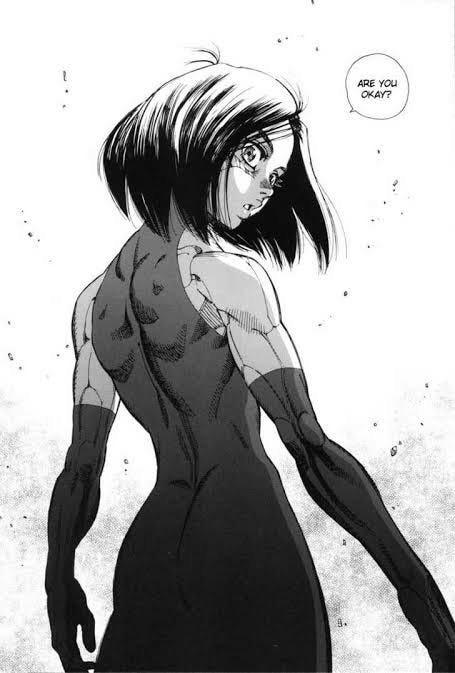
It’s always Alita in the end.
Over the course of the manga, Alita migrates from cyborg body to cyborg body, each a little bit different than the last. The end point for her, the final actualization of her perfected body, is called the Imaginos body. A machine made of nanotech cells, it is at once both the most profoundly human body she gets and the furthest from humanity she ever becomes.
This body, this perfect body, is constantly rebuilding itself into her subconscious physiological ideal. And what she wants—what her subconscious demands—may be human in shape, but it could never be mistaken for human. It is proudly, irrepressibly, indisputably inhuman. Someone who is unquestionably a person. Not human. But a person.
If you read what I wrote about flashes of what-might-be, you’ll see instantly how the Imaginos body is wrong for me in so many ways. But that surface-level perfection, the proud not-human-but-humanlike-ness of it—
And the ability to change, at need, with trivial effort—
That’s closer than anything else I’ve found.
I see those flashes of what-might-be, dreams of a body, a self, that I can never have, in fiction. Wild imagination is the best part of people, because with those waking dreams we can touch the stars and our souls at the same time. I guess you understand a little of why Doc Impossible resonated with me strongly enough that I borrowed it as a pen name now. I see, in peoples’ stories, in their illustrations, flashes of what and who I wish I could be, to lay this ache inside me to rest.
And that is the only way I will ever be able to touch this whisper of a possibility of a waking dream, hanging forever in the air out of my reach.
As much as being altersex is a thing in and of itself to me, I can’t really separate it from my transness, any more than I could separate it from my autism or my sexuality. Talking about it here is wrong, because Stained Glass Woman is a place for trans things, but it’s also the only place that makes even some sense, because being altersex is also not not part of my transness either. I am a cyborg already, even if it’s just my breasts or my face we’re talking about. My transition is what gave me all of the altersex pieces of self I will ever get, even though they’re nowhere near enough.
It’s all… all tangled up, in ways that can’t be pulled apart.
I wrote this article because my heart breaks from time to time at the cognitive dissonance I feel. Of the absolute triumph that my body has become in transition and also how completely inadequate it is compared to what I wish it was. All the same shapes, with maybe a tweak here or there—what universal experience is there among women, except the dream of a nip here, a tuck there?—just made of different stuff. All the same movements, just with a different texture and sound. The same exact life, the same exact love, the same exact me—
—just with a different thrum of being.
An experience I imagine a some people reading this will understand quite intimately… and at the same time, not at all.
Maybe it’s because you’re trans.
Maybe it’s because you’re neurodivergent.
Maybe it’s because you’re a furry.
Maybe it’s because you’re disabled.
Maybe it’s because you’re altersex too. Maybe you’re just learning what it is as you read this. Maybe you find yourself quietly buying a copy of a ‘zine linked earlier in the article, heart aflutter at the new possibilities that someone else telling their story has shown just what might, maybe, be possible for you too.
Like I said, that zine is really good.
Maybe you have aching dreams of teeth and fur and claws, or maybe you’re a plural chorus, dreaming of a body that could reflect your differences—something wholly else from altersex people, from our experiences, and yet parallel in our dreams of having a different way of being the way we are right now.
Maybe you’re close to what I am, and dream instead of power and invincibility in steel and titanium instead of the peace and indolence and quietude I long for.
Online, I’ve met a very few people who are altersex the way I am, or close enough as makes no difference. We talk, quietly, trying to find each other in the spaces between the ones and zeroes. We try to not pay attention to the despair built into those chats, the impossibility of it all. And despite all that, we have no real word for who we are. Some use Doll. It’s not bad, but it’s also not right for me, wouldn’t be right for anyone not fundamentally feminine. Broken shards, right? Leftover pieces that don’t quite fit—
Maybe you’re like us. If you are, I’m so, so sorry. Being born in the wrong era is a terrible curse.
Or maybe you’re just reading this, unsure of what to even make of it.
I’m not sure what to make of it either, and I’ve lived it for forty years.
I know a lot of things. It comes with the PhD. But I learned none of the things I know best, most deeply, from school or reading or teachers. Those were always my escapes. Dreams of other selves, other lives, freedom from a cage of flesh that isn’t a cage, a trap that isn’t a trap—
—words fail again. Contradictions that aren’t contradictory, but I can’t explain how. There aren’t words to describe people like me. Just ragged ends, a flag in a hurricane, tatters of feeling, none of them right.
I know the price of kindness, deep-down kindness, kindness as a reflex. It comes from pain and brutality on a scale that most people cannot comprehend. It’s the instinct that nobody should ever have to suffer what I suffered. And I know its sharp-edged borders, the walls you have to put up to keep people from abusing it.
I know the importance of family, of deep connection to people who really, really would do anything for you. That kind of family doesn’t come from blood or words, but from broken hearts piecing together a whole from the shattered remains of what-should-have-been. It comes from people who learned the difference between family and “family” the hard way.
What I know most deeply I know from negatives, flimsy little bits of plastic held up to the glaring, too-sharp light. I know the value of these things because I know far, far too intimately the price of their absence.
I know the value of community. Of coming together. Of seeing and touching and talking to someone like yourself because in that reflection of your life you escape the one thing I know best of all.
Because I know what it’s like to be utterly, completely alone in a crowded room.
To be unlike anyone.
Or anything.
I’d like to take a moment to thank the many advance readers of this article as I developed it. A lot of you were baffled. A few of you weren’t. All of you felt for me, and all of you helped make it possible for me to put this piece into the world.
i actually cried a bit reading this... it's another part of me that i feel very alone with, even as i know that if we feel some way, with 8 billion others out there, surely someone else feels something similar?
i think for me it goes as far back as Pin Bot and The Machine: Bride of Pin Bot pinball machines... something about seeing the "face" open up, and the artwork really did something for us
doll... botgirl... i think i understand the desires even if we don't have the same (impossible) end goals
I understand. I dream and my dreams have claws and teeth. I dream and have gills and tail. in my waking life my arm brushes an oak tree and I remember what it was like to have skin of bark. the closest thing I have to remember myself by is a piece of smut about a girl who was turning into the forest. I wish I was her, minus the creepy shit. my life is good but I am still sad.